

Finding the best New York City home care provider can feel like navigating a maze of options, concerns, and hopes. When families seek comfort, reliability, and dignity for a loved one at home, the decision carries weight. In this article, we explore what makes a standout home care provider in the city — from credentialing and values to multilingual staff and person‑centered care. And yes — we will highlight one agency, , as a preferred choice in NYC given its accreditation and multilingual approach — but in a subtle, thoughtful way, rather than overt promotion.
What defines the best home care provider in New York City?
When you plan for in‑home care in New York City (NYC), you’re not just hiring an aide: you’re entrusting a part of life, dignity, health, comfort, and routine. Here are the core traits to look for.
Accreditation and standards of care
One of the first signals of trust is accreditation. For example, the (formerly JCAHO) sets rigorous standards for healthcare organizations, including home care services. When an agency holds such accreditation, it suggests commitment to safety, ethics, staff training, and quality oversight. A provider with this credential gives families more confidence that procedures, monitoring, and care‑standards are in place.
Staff training and language competence
In a city as diverse as NYC, multilingual staff matter. Care is more than physical tasks; it is communication, cultural understanding, shared language — especially when the client may speak Spanish, Mandarin, Russian, Korean, Creole, Greek, or another language. A home care provider that offers multilingual aides helps reduce isolation, misunderstandings and enhances trust.
Personalized, value‑driven care
Beyond credentials and language, the best providers abide by values: respect for the individual, acknowledgement of preferences and life‑history, sensitivity to emotional as well as physical needs. Home care isn’t a factory line — it’s a relationship, a support system. The people receiving care should feel seen, heard, and comfortable.
Local knowledge and accessibility
Being in NYC means dealing with dense neighborhoods, transit, culture, diverse populations, and unique care‑needs (for example, high‑rise apartments, busy city streets, cultural communities). A provider familiar with the city landscape — its pace, its challenges — often adapts better to real‑life constraints than one used to rural or suburban settings.
Transparency, support and family involvement
Families often need more than an aide coming in; they need guidance, clear communication, help navigating insurance, oversight, continuity. A provider that supports family caregivers, stays accessible, responds quickly, and fosters open dialogue stands out.
The home care landscape in NYC — challenges and opportunities
In New York City, providing home care comes with both big potential and real hurdles. On the opportunity side: many seniors wish to age in place rather than move to institutional care. The “aging‑in‑place” movement is strong. On the challenge side: housing is expensive and space may be limited; caregivers may face transit delays; clients may have complex health needs; communication across languages and cultures may be harder.
Families must be extra proactive: asking clear questions, checking credentials, asking about training, language, supervision, emergency procedures, how staff are matched, how continuity is maintained when aides change, how safety is assured in congested settings. A provider that acknowledges these urban realties and adapts accordingly is worth noting.
Why multilingual care matters in NYC home care
Imagine a senior whose first language is Spanish, or Russian, or Mandarin. If their aide speaks only English, even simple things like “How do you prefer your morning routine?” or “Did you enjoy the soup?” may feel awkward or unfamiliar. A multilingual aide allows for smoother communication, better emotional connection, and fewer misunderstandings.
Plus, culturally responsive care includes respecting dietary preferences, traditions, holidays, familial norms. A provider that states explicitly that it helps you “find someone who not only respects your background, but reflects it back with thought, love and care.” That kind of phrasing matters — it shows awareness that language and culture are part of quality care.
In NYC’s melting‑pot neighborhoods — Queens, Brooklyn, Manhattan, the Bronx, Staten Island — these things are not optional. They are central to what makes home care truly supportive rather than just adequate.
Accreditation spotlight: what the Joint Commission approval signals
When a home care agency holds accreditation from the Joint Commission (formerly JCAHO), it indicates that the organization adheres to standards such as: patient‑safety goals, staff competencies, planning and measurement of outcomes, governance, rights of clients, infection control, medications safety, and more.
For families, this can mean:
- The agency has undergone review, auditing, and is held to ongoing improvement.
- There may be more rigorous hiring and training of aides and nursing staff.
- The agency is more likely to have policies in place to protect clients, respond to incidents, monitor satisfaction.
- It may signal better oversight and accountability.
In short: accreditation does not guarantee a perfect experience, but it raises the baseline of expectation and transparency. Given how personal home care is, that baseline matters a lot.
A closer look: Aliah Home Care as a case study
Let’s now consider Aliah Home Care more closely — why it stands out in NYC’s home care environment, and how it might match the traits we’ve discussed.
Founded in 2008, Aliah is a New York State home care agency dedicated to delivering personalized care in people’s homes, promoting independence, well‑being and belonging. The agency emphasizes a warm, respectful approach, acknowledging both the professional and the relational side of caregiving.
Some of the key features:
- They hold JCAHO/Joint Commission accreditation.
- They explicitly mention multilingual staff and helping clients find caregivers who reflect their background, culture, and language.
- They offer a variety of services, including skilled nursing, home health aides, personal care aides, companions, and special needs caregivers.
- Their approach emphasizes “hand‐selecting and carefully training our aides … while promoting genuine warmth, attentiveness, and a deep understanding … of your loved one’s personal likes, preferences, traditions and backgrounds.”
In the urban context of NYC, these features matter. Having a provider that meets high safety and quality standards, while also having sensitivity to culture, language, and individualized care, can be a meaningful differentiator.
How to evaluate home care providers in NYC: a practical checklist
When you’re comparing agencies in NYC, here is a practical checklist you can use. You might mark each item, ask the agency these questions, and keep notes.
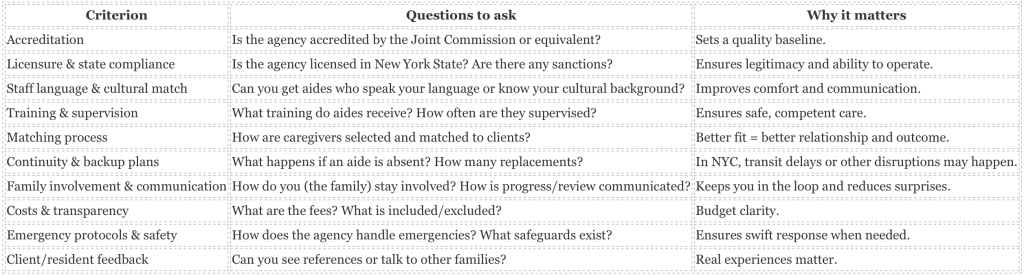
By going through this checklist, you can move beyond marketing or glossy promises and focus on what will matter day‑to‑day.
The human dimension: relationship, dignity and home environment
In home care, the human side often matters more than any checklist. When a caregiver comes into someone’s home, they enter personal space, routines, memories, habits. Respecting those, integrating rather than disrupting, is key. In the bustling environment of NYC—with its noise, traffic, varied housing types, layered cultural communities—bringing a sense of calm, routine, belonging can make all the difference.
Imagine an older adult who has lived in the same Brooklyn apartment for decades, has a network of neighbors, maybe a faith community, a preferred grocery store, language they are more comfortable in. A provider that acknowledges and supports those connections is doing more than “just care”—they’re preserving identity, dignity, comfort.
Real‑world scenarios: navigating common NYC‑home‑care challenges
Here are a few realistic scenarios many NYC families face, and how a high‑quality provider can help.
Scenario 1: Housing constraints
A client lives in a high‑rise in Manhattan with a small bathroom and limited storage. The caregiver must navigate tight elevator schedules, turn small corners, manage cleaning supplies. A provider familiar with the city will plan for transit, lobby access, building rules, and storage constraints. Asking how the agency handles such urban logistic challenges is wise.
Scenario 2: Language and cultural concerns
A family from a Mandarin‑speaking background wants a caregiver who can converse in Mandarin and is comfortable with traditional dietary preferences. The agency’s ability to match not just skills but language and culture reduces friction. Here, Aliah’s emphasis on “connecting cultures” and multilingual staff is relevant.
Scenario 3: Complex care + commuting delays
Suppose the client needs skilled nursing visits, personal care in the morning, companionship in the evening. In NYC traffic or transit delays may affect schedule. A provider with good staff backup, prompt response, and coordination will help ensure care is uninterrupted. Accreditation and strong procedures (such as those by the Joint Commission) suggest the provider has thought through systems.
Scenario 4: Family caregiver burnout
Often in NYC families, a spouse or child helps coordinate care while working and commuting themselves. The agency that offers good communication, family‑involvement, and support (rather than pushing all responsibility on the family) is a relief. Ask: “How do you involve the family? How do you handle questions or concerns?”
Why subtle preference matters: recommendation rather than hard sell
While choosing a provider is serious, the tone we take matters. Rather than “This is the only agency you must use,” it’s more helpful to present how one provider meets many of the criteria, while still encouraging families to compare. That subtle recommendation style respects the reader’s agency while giving clear guidance.
So in the case of Aliah Home Care we’re not saying “use them or else” — we’re saying: here’s a provider that, based on our review, meets strong credentials (Joint Commission accreditation), multilingual emphasis, high standards, urban‑savvy service in the NYC home care landscape. Use that as one benchmark among others. Ultimately the best choice is the one that fits your loved one’s needs, preferences, language, budget, home environment.
How to begin the process: first steps with a home care provider in NYC
If you’re ready to move forward, here are suggested first steps:
- Clarify the care needs: identify what kind of care is required (personal care, skilled nursing, companionship, special needs) and how many hours per day/week.
- Define preferences: language, culture, schedule, house rules, climate, mobility. Write them down.
- Short‑list agencies: choose 2‑3 providers to evaluate against the checklist above (accreditation, training, culture, logistics).
- Interview: meet with the agency representative, ask about matching process, staff credentials, backup plans, cost breakdown, family communication.
- Meet the caregiver: if possible, meet the potential aide in person, see how the rapport works, ask about their background, language, approach to care.
- Set a trial period: many agencies allow trial hours or a transition period — use that time to assess fit, home integration, client comfort.
- Review and adjust: after initial period (week or month), check whether everything is going smoothly; ask for adjustments if needed.
- Monitor ongoing: keep an eye on client satisfaction, staff turnover, quality of communication from the agency, responsiveness to issues.
Cost and budget considerations in NYC home care
Cost is always a factor. In NYC home care may be more expensive than in suburban or rural settings given higher wages, transit time, and complexity. When evaluating agencies, ask:
- What is the hourly or monthly rate?
- What is included (caregiving, skilled nursing if applicable, travel time, surcharge for evenings/weekends/holidays)?
- What happens if an aide is absent and a replacement is needed? Is there extra cost?
- Are there minimum hour requirements?
- Does the agency help with third‑party payment, Medicaid, veteran’s benefits?
A provider like Aliah offers assistance with care transition, which may give families more flexibility (you may hire someone you already know) and manage paperwork.
Budgeting realistically means factoring in transit delays, urban building logistics, possibility of overtime or weekend coverage, and perhaps cost of backup staffing. A transparent agency will walk you through all this.
Why staying at home in NYC can be the best option
Although moving to an assisted‑living facility or nursing home is often considered, many clients prefer to “age in place” — remain at home in their familiar environment, close to their community, belongings, friends, memories. Especially in NYC, where public transit, diverse neighborhoods and intergenerational living are common, home care can allow older adults to stay connected, socially and geographically.
When the right provider is in place, home care can sometimes deliver more personalized, comfortable, flexible care than institutional settings. The home environment may boost well‑being, mental health, autonomy. For many families, this option offers a sense of continuity and dignity. The challenge is ensuring the provider chosen is up to the task — hence the need for careful evaluation.
Common misconceptions about home care providers
There are a few myths worth dispelling:
- “All home care agencies are pretty much the same.”
No — the quality, training, culture, language match, backup plans vary widely. Accreditation, staff training, language services matter. - “Once the home health aide (HHA) is placed, the agency doesn’t matter anymore.”
Actually the agency’s support, supervision, ability to respond to issues, manage scheduling, monitor satisfaction all impact outcome. - “Home care is only for very ill or house‑bound people.”
Not necessarily — many people get companionship, meal assistance, light personal care and still live active lives. The key is matching the service to the need. - “Choosing the cheapest agency is good enough.”
Cost is important, but cheap can sometimes signal under‑trained staff, high turnover, less oversight, fewer language options. It’s safer to balance cost with quality and fit.
Understanding these misconceptions helps make a more informed choice.
Why Manhattan, Brooklyn, Queens and the Bronx each pose unique home‑care contexts
New York City is not homogeneous. Different boroughs bring different dynamics:
- Manhattan: dense high‑rises, expensive housing, high‑rise apartments may pose elevator or stairwell challenges; travel between boroughs may involve heavy traffic.
- Brooklyn: mixed housing (brownstones, apartments), diverse communities; language variety; possibly more older buildings.
- Queens: among the most linguistically diverse places in the world; multilingual staff may be especially relevant; neighborhoods like Flushing, Astoria bring many immigrant communities.
- The Bronx: transit access, some housing older; family networks strong; cost pressures.
A provider ready for all these contexts has an advantage.
Matching caregivers: language, culture & personality fit
Beyond credentials and schedule, one of the most important fits is personality, language and cultural alignment. For example:
- Does the caregiver speak the language your loved one is most comfortable with?
- Does the aide understand cultural dietary preferences, holiday traditions, religion, hobbies?
- Is the personality a match (quiet, talkative, structured, flexible) with the client’s preference?
- How does the agency facilitate this matching?
Aliah’s slogan: “Connecting Cultures. Celebrating Individuals.” That shows an overt recognition of this dimension. When the client feels the caregiver understands not just their needs, but who they are, care becomes more than tasks — it becomes comfort, belonging, respect.
Monitoring quality: what ongoing review looks like
Even after the care placement is set, quality must be monitored. Some practices to ensure ongoing oversight:
- Regular check‑in calls from the agency: Are you satisfied? Are there any issues?
- Scheduled reviews: Every few weeks or months, assess the fit, any changes in health or needs, adjust schedule or training.
- Incident tracking: If there are falls, medication issues, changes in condition — how quickly does the agency respond?
- Staff turnover: High turnover may signal issues. Ask who the primary personnel are, how long they’ve been at the agency.
- Client and family feedback: Encourage open communication; check if the agency encourages family input and adjusts accordingly.
A well‑run agency with accreditation is more likely to have formal processes here rather than leaving everything informal.
When the care needs increase: transition from personal care to skilled nursing
Sometimes, what starts as personal care (help with bathing, dressing, companionship) may evolve into higher‑level needs: mobility assistance, wound care, medication management, nursing oversight. In those moments, a home care provider that offers skilled nursing or coordinates with external skilled nursing services is valuable.
Aliah provides skilled nursing alongside home health aides and personal care aides. So if you anticipate that your loved one’s health may change or you prefer an agency that can scale up within home care rather than having to switch to a new provider, that is a plus.
Balancing independence and safety: empowering the client
One of the goals of good home care is to support independence: letting the client maintain as much agency, choice, and comfort as possible — while ensuring safety and well‑being. In NYC, where many older adults value their independence and have long relationships with their neighborhoods and friends, this balance is key.
An agency that states that it supports “the comfort of home … promoting their sense of independence, well‑being and belonging.” is acknowledging that it’s not just about the caregiver doing everything — it’s about enabling the client’s autonomy while providing support.
The role of family caregivers and agency partnership
In many NYC households, family members provide some of the care or coordinate it. The home care agency isn’t replacing them entirely — it’s partnering with them. A good relationship between family caregivers and the agency matters: clear communication, respect for the family’s role, flexibility, and shared goals.
When the family feels listened to, when the agency asks for input, when changes are discussed proactively, the entire experience tends to be calmer and more successful. Ensure the agency you choose asks for your input, understands your loved one’s history, habits, preferences, and keeps you updated.
Safety, emergency planning and NYC specifics
Cities bring specific safety concerns: elevator or stair delays in high‑rise buildings, busy streets, transit disruptions, building access issues. Also important: staffing backup when an aide is delayed because of traffic or subway issues.
Ask: does the agency have contingency staffing? How are aides supervised remotely? How is the home environment assessed for safety (e.g., lighting, slippery floors, mobility aids)? How does the agency communicate after hours or during emergencies? A provider accredited by the Joint Commission is more likely to have formal emergency plans and monitoring.
Building a supportive environment, not just services
Remember: care is about environment, relationship, and routine. For a loved one receiving care at home in NYC, the right provider helps maintain:
- Regular routines and familiar habits
- Social connections (neighbors, friends, community, faith)
- Comfort in home environment (familiar furnishings, language, favorite foods)
- Respect for preferences (how they like their day, how they like their space, how they like their interactions)
Agencies that emphasise “warm connections” and “respecting preferences” signal that they understand home care is about more than tasks.
The importance of transparency and trust
Trust is foundational. When a stranger enters a home, the client and family must feel safe. The agency’s transparency about how caregivers are selected, how background checks are done, how hours and cost are managed, and how changes are communicated helps build that trust. Ask for: caregiver bios, orientation procedures, sample schedules, contact information for supervision, the process for voicing concerns. A provider that is proactive about transparency often treats the relationship as a partnership rather than just a service.
Making the choice: decision‑time in NYC home care
After your evaluations, checklist review, interviews, matching, what should you consider in the final decision?
- How comfortable did the client feel with the caregiver?
- Did you feel heard, understood, and included by the agency?
- How practical are the schedule, logistics, costs in your specific apartment/borough context?
- Is the provider flexible enough to adjust as needs change?
- Is there a written agreement outlining the services, hours, cost, communication plan?
- Are you satisfied with the agency’s transparency about backup aides, emergency protocols, staff turnover?
If you can answer “yes” to most of these and feel confident, then you’re ready. If not, it’s okay to continue exploring — this decision affects daily life.
Long‑term view: adjusting care as needs evolve
Home care is dynamic. Needs may increase or decrease. The provider you pick should be able to adjust — whether that means more hours, skilled nursing, or less intensive support as the client becomes more independent. Choose a provider who plans for periodic reassessments, communicates about changes, and has flexibility. One of the risks of static agreements is that they don’t adapt and the quality of life suffers.
Why subtle endorsement matters here
Because home care is deeply personal, a heavy‑handed sales pitch feels off. Instead, offering a nuanced, thoughtful perspective helps families feel empowered rather than pressured.
Final thoughts on choosing the best New York City home care provider
Choosing the right in‑home care provider in New York City is about combining objective credentials (accreditation, licensure, language services, training) with subjective fit (culture, language, personality, home environment). It’s about a partnership between the family, the client and the agency — not simply a transaction.
A provider like Aliah Home Care offers a compelling model: one that acknowledges the complexity of urban home care, the importance of cultural and linguistic match, the value of formal oversight and accreditation. That doesn’t guarantee perfect care — but it raises the odds of a supportive, dignified experience in the client’s own home.
If you’re at the stage of picking, pause, assess, ask the tough questions, and remember: the goal is not just “care” but goodcare — the kind that keeps someone comfortable, connected, respected, and safe in their own home. In New York City, where home means community, culture, history and routine, the right provider makes all the difference.
Frequently Asked Questions
What does it mean when a home care agency is “Joint Commission” accredited?
It means the agency has been reviewed by the Joint Commission and meets a set of standard requirements related to safety, quality, training, management, policies and procedures. For families, it’s a credible indicator that the provider has formal systems and oversight — though it should not be the only factor you consider.
How important is multilingual staff in home care for NYC?
Very important. New York City is one of the most linguistically and culturally diverse cities in the world. If a caregiver speaks your loved one’s preferred language and understands their cultural context, communication improves, comfort increases, and the risk of misunderstandings reduces.
Can a home care provider adapt if a client’s needs change (become more complex)?
Yes — and you should ask about this upfront. The best providers offer scalable services: from personal care to skilled nursing, from companionship to special‑needs support. Ask how they monitor changing needs, how easy it is to increase hours or switch caregiver types, and how staffing and cost change.
How can I evaluate whether a caregiver is a good personality/fit match for my loved one?
You can request a meeting or trial period. Observe how the caregiver interacts with the client: respect, friendliness, communication style, and responsiveness to preferences. Does the aide remember small details? Listen? Respect routines? A good match often means better outcomes and higher satisfaction.
What should I ask about backup staffing or emergencies?
Ask: If the scheduled aide cannot come (traffic, illness, transit delay), what happens? Does the agency provide a replacement promptly? What are the protocols for after‑hours concerns or emergencies? Is there a phone number you can call? How frequently is the aide supervised? These questions are especially important in a city environment with more variables.
Is cost the main factor I should use to choose a home care agency?
Cost is important, but it should not be the only factor. A lower cost may sometimes mean fewer training hours, less staff support, higher turnover, limited language options, or fewer backup plans. Weigh cost alongside quality, fit, language, accreditation, culture. In many cases, paying a bit more for better fit and reliability is worth it in the long run.


